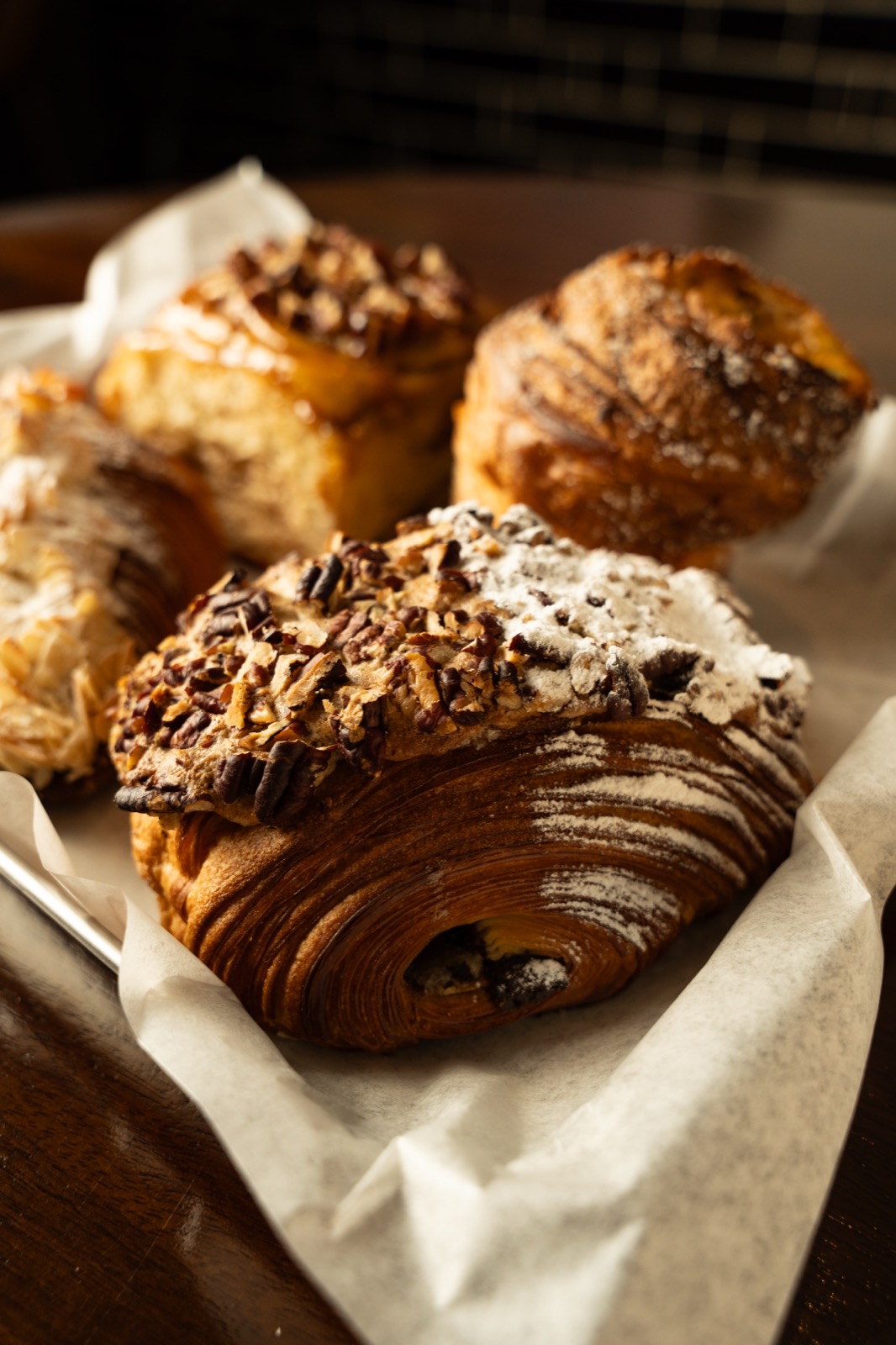
Most croissants in Dubai are made with commercial yeast. They're fine. They're consistent. They're also forgettable by the time you've finished your coffee. Ours are different, and not in a vague, hand-wavy way. The difference is specific, it's structural, and it starts two days before you ever walk through the door.
Here's exactly how we make our sourdough croissants, step by step. No mysticism. Just the work.
It Starts with the Starter
Everything at Bada Bing begins with our sourdough starter. The same live culture that goes into our Roman pizza dough and our sandwich loaves is the leavening agent in these croissants. We feed it daily. We know how it behaves in Dubai's humidity. We know when it's at peak activity, and that's the only moment we use it in a dough.
Using a starter instead of commercial yeast means the dough ferments more slowly. That slower fermentation produces organic acids, the same ones responsible for that faint tang you get in the finished croissant. It's not sour the way a San Francisco loaf is sour. It's more of a depth, a complexity that sits underneath the butter and makes you want another bite to figure out what you're tasting.
The Dough: Day One
We mix the détrempe, which is the base dough, in the morning. It contains flour, the active starter, whole milk, a small amount of sugar, salt, and a touch of butter worked in at the end. The hydration is kept deliberately low. A wetter dough would tear during lamination, and torn layers mean a croissant that doesn't open properly when it bakes.
Once mixed, the dough gets a short rest at room temperature, then goes straight into cold fermentation overnight. The cold slows everything down and lets the gluten relax without overproofing. This is non-negotiable. Rush this stage and the dough fights you on the sheeter the next morning.
Lamination: Where the Layers Come From
Day two is lamination day. This is the part that separates a proper croissant from a roll that got shaped into a crescent.
We take the cold dough and encase a slab of high-fat European butter inside it. The butter needs to be cold but pliable, meaning it bends without shattering and without melting into the dough. Getting this right in Dubai requires working quickly and keeping the kitchen cold. We do not compromise on the butter temperature. A warm butter block smears into the dough layers instead of staying distinct between them, and smeared butter means no honeycomb, no shatter, no point.
From there, we roll and fold. We give the dough a series of turns, each one creating more layers. Each fold is followed by a rest in the refrigerator. We repeat this process until we have the layer count we want. That rest between folds isn't downtime. It's the gluten relaxing so the next roll doesn't spring back and compress the layers we just created.
By the time lamination is done, a single sheet of dough contains dozens of alternating layers of dough and butter. When that goes into a hot oven, the water in the butter converts to steam and pushes those layers apart. That's where the flake comes from. That's where the open, airy interior comes from. Steam does the work that was set up two days ago.
Shaping and the Final Proof
We cut the laminated dough into triangles and roll each one by hand from the wide end to the point. The tension applied during shaping determines how the croissant holds its shape in the oven and how the curl sits. Too tight and it won't expand properly. Too loose and it spreads flat.
After shaping, the croissants go into their final proof. Because we're working with a sourdough starter rather than commercial yeast, this proof takes longer. We watch them, not the clock. We're looking for a specific jiggle when you shake the tray, a wobble that tells you the layers are aerated and the dough is ready. This judgment call is something you develop over time and a lot of failed batches.
The Bake
Egg wash goes on before they go into the oven, two coats applied carefully so the wash doesn't drip down the sides and glue the layers shut. The oven is hot. The bake is relatively short. We're looking for a deep amber colour across the whole surface, not just the top. Pale underneath means underbaked, and an underbaked sourdough croissant is gummy in the centre because the starter's acids haven't fully set.
Out of the oven, they cool on a rack for at least twenty minutes. Cutting into a croissant straight from the oven collapses the structure before it's set. We know. We've done it. Don't do it.
Why Bother
The honest answer is that we don't know how to do it any other way. Our whole operation is built on the same sourdough starter, applied consistently across pizza, bread, and pastry. Swapping in commercial yeast for the croissants would be faster, cheaper, and easier to standardise. It would also produce a different product entirely, one that doesn't belong in this bakehouse.
You can find our croissants at Dream Tower 2 in Dubai Marina, made fresh every morning. Come early. They go.