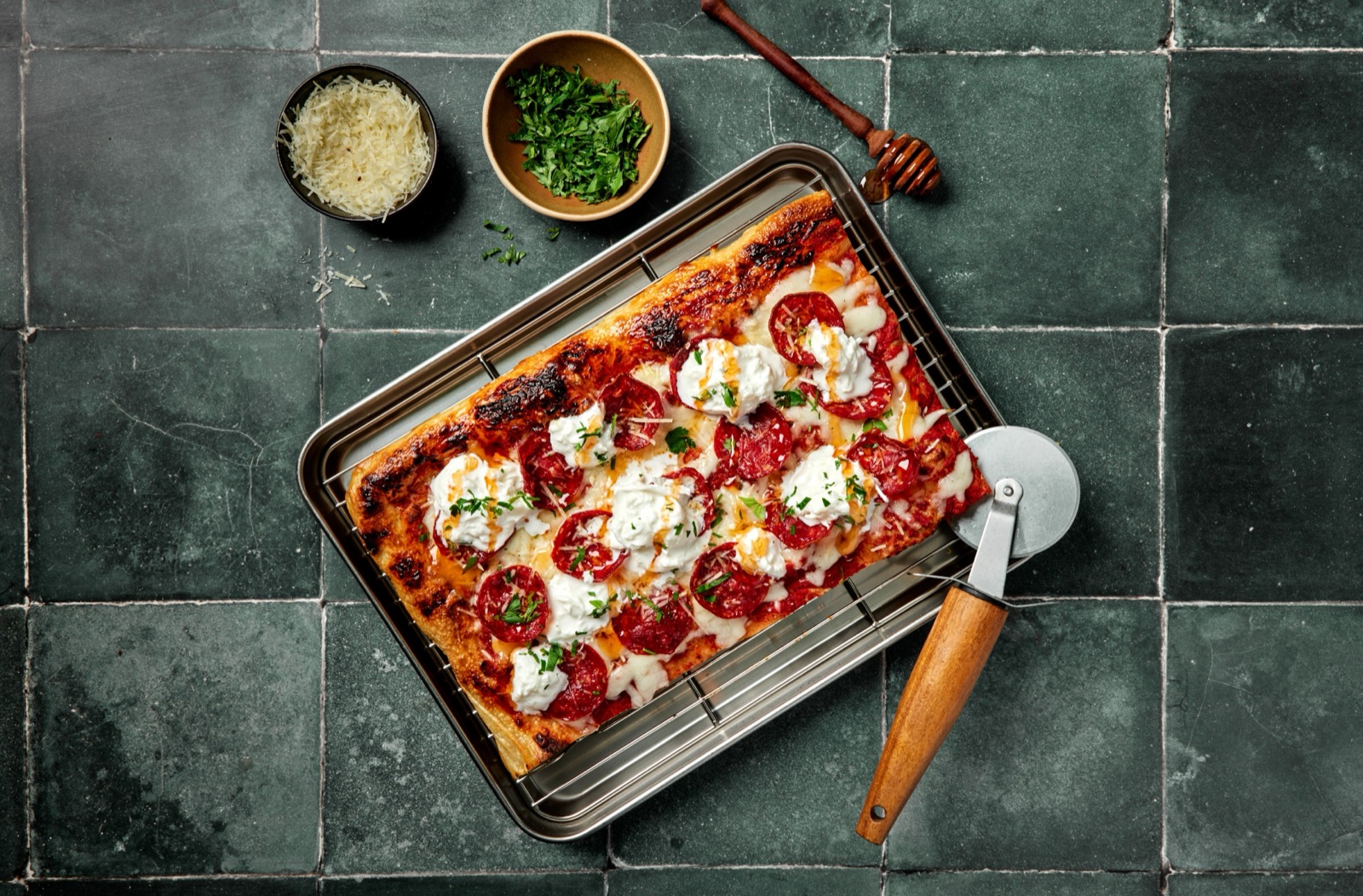
Most pizza dough is ready in two to four hours. Yeast goes in, the dough rises, it gets shaped and baked. Fast, functional, forgettable. Our dough sits in cold fermentation for a minimum of 72 hours before it ever sees the inside of an oven. That is not a marketing number. It is a biological timeline, and understanding why it exists explains everything about why Roman pizza al taglio is in a category of its own.
What Fermentation Actually Does
Fermentation is the process by which microorganisms, in our case a live sourdough starter, consume the sugars in flour and produce carbon dioxide, organic acids, and a long list of flavour compounds as byproducts. Carbon dioxide creates the open, irregular crumb structure you see when you cut through a good slice. The acids, primarily lactic and acetic, are what give sourdough its characteristic depth and slight tang. Neither of those things happens fast.
A quick-rise dough inflated with commercial yeast produces carbon dioxide at speed, but the fermentation window is too short to generate meaningful flavour complexity. You get air. You get chew. You do not get the layered, slightly nutty, gently sour character that makes a piece of Roman pizza worth eating on its own, before a single topping goes on.
Why 72 Hours and Not 24
The difference between a 24-hour and a 72-hour ferment is not incremental. It is categorical. In the first 24 hours, the primary yeast activity dominates. The dough rises, gluten relaxes, and early flavour compounds begin to develop. By hour 48, the bacterial activity catches up. Lactobacillus cultures, the same family of bacteria responsible for yoghurt and aged cheese, produce lactic acid at a meaningful rate. The flavour deepens. The gluten network becomes more extensible, meaning the dough can hold a much higher hydration without tearing. At 72 hours, you are working with a fully mature dough. The flavour is complex. The structure is stable. The digestibility is measurably better because extended fermentation breaks down a significant portion of the gluten and phytic acid that many people find difficult to process.
That last point matters more than people expect. Guests who tell us they usually feel heavy after pizza consistently report feeling fine after eating ours. That is the fermentation doing its job.
High Hydration and Why It Requires Time
Roman pizza al taglio is baked in rectangular steel trays at high hydration, typically between 75 and 85 percent water to flour by weight. For context, a standard Neapolitan dough runs closer to 60 percent. High hydration is what produces the signature base of Roman pizza: a light, almost focaccia-like interior with a crisp, caramelised underside. But high hydration dough is difficult to handle. It is slack, sticky, and unforgiving.
Extended cold fermentation solves this. As the gluten develops over 72 hours, it forms tighter, more organised protein networks that can trap water without collapsing. The dough becomes workable. It holds its shape during the stretch into the tray. It bakes evenly. Try to rush a high-hydration dough and you get a flat, dense result. The structure simply is not there yet.
Cold Fermentation Specifically
Temperature controls the speed of fermentation. At room temperature, 72 hours would over-ferment the dough entirely, consuming too much of the available sugar and producing an acidic, structurally weak result. Cold fermentation, done in a refrigerator between 2 and 4 degrees Celsius, slows the yeast activity dramatically while allowing the bacterial and enzymatic processes to continue at a measured pace. You get all the flavour development without the collapse. The cold also gives the baker control. Every batch behaves predictably because the variables are managed across the full three days.
What This Means on the Tray
When you pick up a slice at Bada Bing, the bottom should be audibly crisp. The interior should be open and light, not bready or dense. The flavour of the base itself should be present before the toppings register, because good pizza dough is not a neutral vehicle. It is half the dish. That is what 72-hour fermentation produces. A base that pulls its weight.
The same dough goes into our sourdough sandwiches and underpins our pastries, from the croissants to the bomboloni to the cinnamon rolls. The starter that drives all of it has been maintained and fed continuously since we opened. It is a living system, and we treat it accordingly.
You can taste the difference. Come in and do exactly that.