There is a version of this story where we tell you ingredient sourcing is complicated, nuanced, full of trade-offs. It is not. San Marzano tomatoes and daily-delivered fresh mozzarella are simply the correct choices for Roman pizza al taglio. Everything else is a compromise. We do not do compromise.
Our dough gets 72 hours of cold fermentation. Our sourdough starter is fed daily. The Roman al taglio method we use demands that every component meets the same standard as the base beneath it. So when it came time to decide what goes on top, the answer was obvious before we even asked the question.
The Tomato Question
San Marzano tomatoes grow in the volcanic plains south of Naples, in the Agro Sarnese-Nocerino valley. The soil there is what makes them different. High mineral content, good drainage, a specific microclimate. You cannot replicate those conditions somewhere else and get the same tomato. People have tried. They keep trying. It does not work.
What you get from a true DOP San Marzano, the kind with the certification stamp and the whole plum shape, is a tomato with low acidity, dense flesh, very little seed mass, and a natural sweetness that does not need sugar added to balance it out. That matters enormously on pizza. A sauce made from inferior tomatoes needs rescuing. You add sugar to cut the acid. You add more seasoning to cover the flatness. You cook it longer to thicken it because the water content is too high. Every intervention is a cover-up.
Our San Marzano sauce gets crushed by hand, seasoned simply, and that is it. The tomato does the work because the tomato is the right tomato. On a Roman base where the dough is the hero, the sauce needs to complement without competing. San Marzano does exactly that. A watery, sharp tomato turns the base soggy and fights the fermented tang of the sourdough. That fight produces nothing worth eating.
We are not going to pretend the cost difference is nothing. Certified DOP San Marzano costs more than generic crushed tomatoes. Considerably more, in fact. We absorb that cost because using cheaper tomatoes would mean producing a worse pizza, and we are not interested in producing worse pizza.
The Mozzarella Question
Fresh mozzarella has a short window. Made today, best today or tomorrow, declining noticeably by day three. That is the biological reality of a fresh pulled-curd cheese with high moisture content. The moment it is made, the clock is running.
Vacuum-packed low-moisture mozzarella does not have this problem, which is why most pizzerias use it. It ships easily, stores for weeks, shreds consistently, and melts in a predictable way. It also tastes like very little. It stretches. It browns. It performs its role without complaint and without distinction. If performance without distinction is what you want, great. It is not what we want.
Our mozzarella is delivered fresh every single day. Fior di latte, made from cow's milk, produced locally and brought to us the same morning it needs to be used. It goes straight onto the pizza. No storage time. No compromise in the flavour from sitting in packaging.
The difference in the mouth is immediate. Fresh fior di latte has a clean, milky sweetness with a slight tang. It melts into pools rather than forming a uniform layer. The texture is yielding rather than rubbery. When it hits the heat and meets a San Marzano base on a properly fermented sourdough crust, what comes out of the oven actually tastes like something. It tastes like the ingredients it is made from, which is precisely the point.
Daily delivery creates a logistical constraint we have chosen to live with. We cannot over-order. We cannot push product to the next day. If we run out, we run out. That occasionally frustrates customers and it occasionally frustrates us. We do it anyway because the alternative is serving cheese that has been sitting around, and we will not do that.
Why This Matters on Roman Dough Specifically
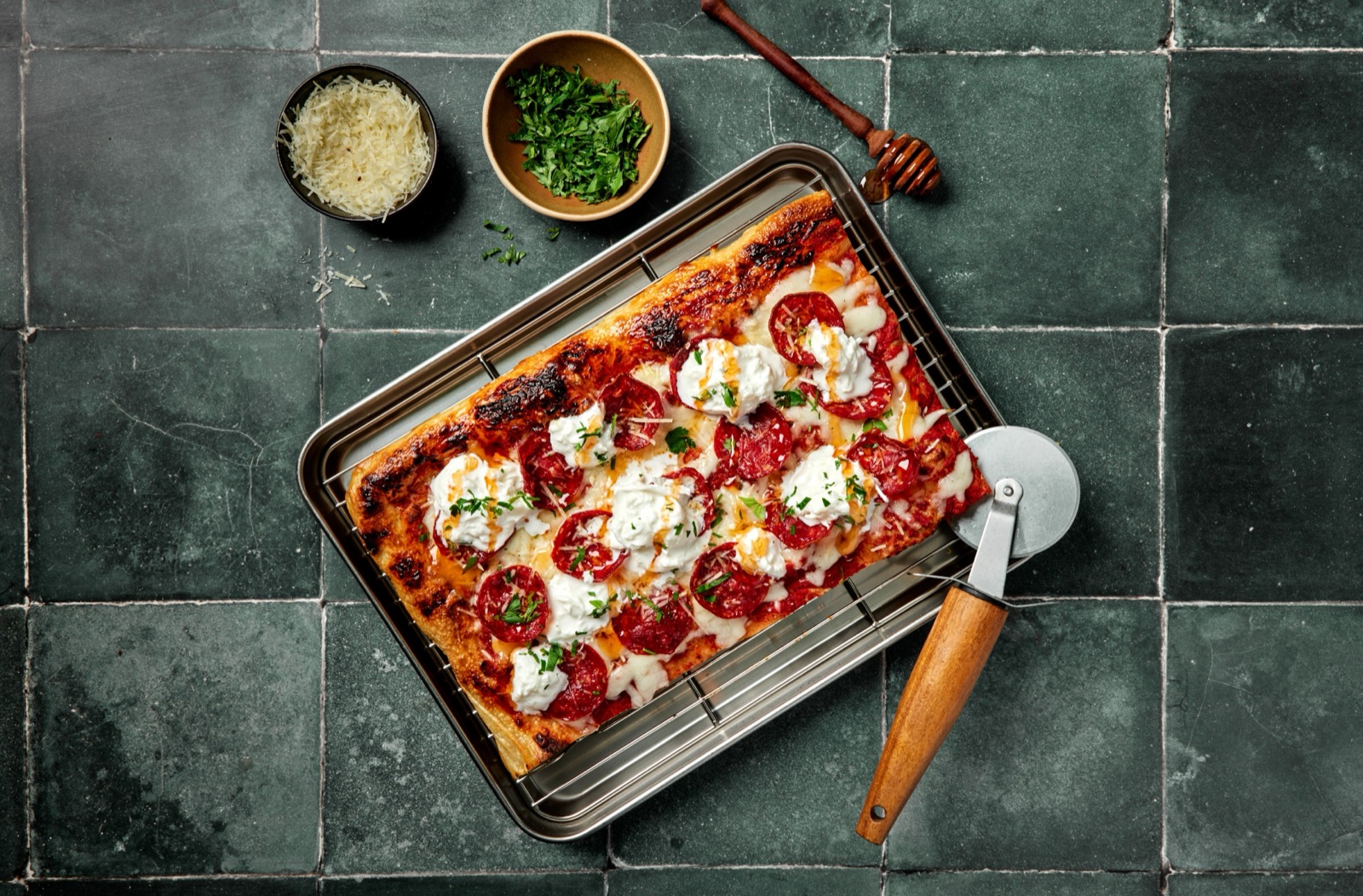
Pizza al taglio is not Neapolitan pizza. The base is thicker, the fermentation is longer, the texture is open and airy with a crisp undercarriage. It is baked in rectangular trays and sold by the slice, cut to order with scissors. The ratio of topping to base is different from a Neapolitan round. You are eating more dough per bite, which means the toppings need to carry genuine flavour or the whole thing becomes bread with decoration on it.
A 72-hour fermented sourdough base has real complexity. Subtle acidity, a slight nuttiness from the long cold proof, a chew that a same-day dough simply cannot produce. That base deserves toppings that meet it. San Marzano and fresh mozzarella meet it. They bring their own character to the conversation instead of sitting there passively.
This is not about prestige ingredients for the sake of prestige. It is about building a pizza where every component is doing its job properly. The dough earns its flavour through 72 hours of fermentation. The tomato earns its place through volcanic soil and a protected designation of origin. The mozzarella earns its place by arriving fresh that morning. Nothing on that tray got there by taking the easy route. That is Bada Bing.